The Vegetarian Newsletter
A Horticultural Sciences Department Extension Publication on
Vegetable and Fruit Crops
Eat your Veggies and Fruits!!!!!
Strategies for the Florida Citrus Industry to Survive the Citrus Greening Disease
Bob Rouse and Fritz Roka, UF/IFAS/SWFREC
Citrus greening, also known as Huanglongbing (HLB) meaning yellow shoot, is considered the most devastating disease of citrus in the world. It is a bacterial disease that greatly reduces production, destroys the economic value of fruit, and causes tree decline to the extent that they are no longer economically productive. HLB originated in Southeast Asia where farmers in southern China first noted the presence of this disease in the late 1800s. It has significantly reduced citrus production in Asia, Africa, the Arabian Peninsula, and Brazil. Once a tree is infected, there is no cure. In areas of the world where citrus greening is endemic, citrus trees decline and may die within a few years. HLB affects all varieties of citrus and citrus relatives and presents no threat to other plants.
The first symptoms of HLB in Florida were found in September 2005 on pummelo leaves and fruit on a dooryard tree in Homestead, Florida. The leaves were tested using PCR (Polymerase Chain Reaction) by the Florida Department of Agriculture & Consumer Services for the bacteria DNA and found positive. HLB is now found in all Florida counties where commercial citrus is produced.
HLB is a plant disease caused by the bacterium Candidatus Liberibacter asiaticus. Researchers have not been able to culture this bacterium in a lab. HLB acts to disrupt the phloem of the tree thereby limiting the flow of carbohydrates to the root system, affecting root health and inhibiting the uptake of nutrients from the soil. Initially this leads to yellowing of leaves, promotion of premature fruit drop, and production of small, misshapen fruit that contain bitter juice with no economic value. As the disease spreads through the tree, the amount of usable fruit produced diminishes until eventually the tree is of no economic value (Brlansky et al. 2011). HLB disease is vectored by Diaphorina citri Kuwayama, an insect commonly known as theAsian citrus psyllid. The psyllid arrived in Florida in 1997 and quickly dispersed throughout the citrus growing regions of the state. The psyllid transports the HLB bacterium from infected trees to healthy trees as they feed on the leaves. A psyllid must be infected to spread the disease. HLB can also be transmitted by grafting diseased budwood. Although citrus greening is bacterial, the disease is not spread by wind or rain or through contact with contaminated personnel and tools as is the bacterial citrus canker disease.
There are two important characteristics of HLB. First, the rate of spread is strongly affected by tree age because the psyllids prefer new growth (Brlansky et al. 2008). Young trees, which are more vigorous than mature trees, produce more flushes and thereby are more susceptible to psyllid feeding and disease transmission. In the case of mature trees, the disease spreads more slowly (Gottwald 2010). Consequently, an infected mature tree is capable of producing usable fruit for several years while at the same time serving as a source of infection for other healthy trees. Second, control through tree eradication is complicated by a latency period between the time a tree first becomes infected and when it begins to express visual symptoms. Once a mature tree is infected, it may not begin to exhibit symptoms of the disease for two or more years. If the rate of incidence in a particular grove is relatively high when the disease is first discovered, a policy of eradication of symptomatic trees may result in destruction of the entire grove.
At this time, there are three strategies available to deal with greening. Strategy 1 is to do nothing. In other words, allow the disease to spread and take no measures to slow its spread or mitigate its impact. This strategy represents a baseline from which to measure the net benefits of Strategies 2 and 3. Strategy 1 has no effect on per acre costs as management tactics are not modified. Per acre revenues, however, are adversely affected as the disease spreads and the number of healthy fruit that can be harvested and utilized gradually declines. At some point, per acre revenues will not cover per acre grove maintenance costs and at that point, the grove is no longer economically viable. The disease spreads faster in younger groves, so younger groves cease to be economically viable faster than an older grove with the same initial infection rate.
Under Strategy 2, an aggressive inspection program is initiated (four or more inspections per year) to identify symptomatic trees, and once found, they are immediately eradicated (Brlansky et al. 2008). An aggressive psyllid insecticide control program is also put into place to suppress psyllid populations. Muraro (2010) has estimated that in Florida, Strategy 2 increased grove maintenance costs by about $450 per acre. The logic behind Strategy 2 is that by eradicating symptomatic trees, the level of inoculum in a particular citrus grove will be gradually reduced. Hopefully the incidence of the disease will eventually be reduced to a point where it can be economically tolerated. There are four problems associated with Strategy 2. First, the latency period of the disease implies that not all diseased trees will be removed, and these asymptomatic trees will serve as a reservoir of the disease inoculums. Second, if a grove is already at a high level of known infection and given that more trees will be infected but not yet symptomatic, it may not be possible to rid a particular grove of the disease without eradicating the entire grove. The probability of this outcome is clearly related to the level of infection when the first positive find is made. Third, eradication or suppression of the disease to a tolerable level in one grove may not be possible if neighboring growers are not adequately suppressing the disease in their groves. The neighboring groves will serve as sources of inoculum, and the disease may be continually re-introduced into the groves of the grower following Strategy 2. Fourth, this strategy is unproven and plant pathologists have yet to characterize the key parameters that would significantly define the timeline by which to control HLB through eradication of symptomatic trees. These parameters include the feasible base level of HLB infection, the number of years it would take to achieve that base level, and the probabilities that young tree resets will survive to productive maturity.
Strategy 3 is an approach first developed in southwest Florida and is, in part, a response to the inherent weaknesses of Strategy 2, or if Strategy 2 is initiated too late. Strategy 3 proposes to treat the visual symptoms of HLB through foliar application of micro and macro nutrients. The tree’s defense response to HLB’s damage to the phloem, the vascular system of the tree, is to produce compounds that block phloem vessels. This damages the root system and inhibits nutrient uptake. With the foliar feeding method, a portion of the nutritional needs of the tree is applied through foliar sprays including macro and micro nutrients (Spann et al. 2010). Symptomatic trees are not removed and scouting for the disease is discontinued. As with Strategy 2, a strong psyllid control program is practiced. Roka, et al. (2010) have estimated that the per acre increase in grove maintenance costs associated with Strategy 3 ranges from $200 to $600 per acre depending on the type and amount of foliar nutritionals a grower decides to apply. While a high rate of disease incidence is one possible reason for adoption of Strategy 3, it is also possible that under some conditions, Strategy 3 yields a higher net present value than Strategy 2, even though Strategy 2 could successfully reduce HLB inoculums to a manageable base level. The primary concern among plant pathologists with Strategy 3 is that HLB inoculum is left unchecked. The economic implications include the uncertainty that young trees (3-8 years old) will reach their productive maturity, whether or not planting the next generation of citrus trees is economically viable, and the increased costs of eradication among those neighboring growers trying to follow an eradication strategy described by Strategy 2. Spatial analysis of disease spread in south Florida suggests that spread among citrus blocks accounts for a more significant portion of disease spread than the spread of the disease within a citrus block (Gottwald et al. 2008). This suggests that heterogeneous control methods may reduce the viability of Strategy 2.
Research evaluating the foliar applied nutritional cocktail developed by citrus grower Maury Boyd in his Orange Hammock grove in Felda, Hendry county, is finding his nutritional cocktail is yielding success in his grove operation. HLB was positively identified in his grove in spring of 2006. Since confirmation of HLB, his Orange Hammock grove has maintained tree health and production having produced five years of normal crops with ‘Hamlin’ and ‘Valencia’ orange yields averaging 574 and 457 boxes/acre, respectively. Mr. Boyd uses a foliar spray cocktail of nutrients and SAR products applied three times per year with the initiation of new vegetative flush. Much of Mr. Boyd’s success has been attributed to his nutrient/SAR (Systemic Acquired Resistance) foliage spray program’s ability to ameliorate the leaf symptoms of HLB allowing the tree to remain productive. The products in the foliar-applied nutrient/SAR cocktail have been published (Giles, 2009). The grove has been on an intense spray program to manage the Asian citrus psyllid. Insecticide sprays are applied at low volume (5 to 10 gallons per acre) by fixed-wing aircraft on a five-week application schedule during the growing season. Other citrus growers have seen the success of Mr. Boyd’s foliar nutrition program and have begun similar programs in their groves. Currently more the 80% of all Florida growers have adopted a foliar nutrient program to maintain their tree health and productivity, and are seeing positive results.
References:
Brlansky, R.H., M.M. Dewdney, and M.E. Rogers. 2011. 2011 Florida Citrus Pest Management Guide: Huanglongbing (Citrus Greening). Publication #PP-225. Gainesville: Institute of Food and Agricultural Sciences, University of Florida. Available online at http://edis.ifas.ufl.edu/cg086.
Giles, Frank. 2009. An alternative approach. Florida Grower. 102, 6-8
Gottwald, T.R. 2010. Current Epidemiological Understanding of Citrus Huanglongbing. Annual Review of Phytopathology. 48:119-39.
Gottwald, T.R., M. Irey, T. Gast, and E. Taylor. 2008. HLB Survival Analysis – A Spatiotemporal Assessment of the Threat of an HLB-Positive Tree to it Neighbors. International Research Conference on Huanglongbing. Orlanda, FL Dec. 2008.
Muraro, R.P. 2010. Costs of Managing HLB and Citrus Black Spot. Presented at 2010 Citrus Expo. Ft. Meyers, FL. May 19, 2010.
Roka, F. R. Muraro, A. Morris. 2010. Economics of HLB Management: Pull Trees or Spray Nutritionals. International Citrus Economics Conference, Orlando, FL. Oct. 2010.
Spann, T.M., R.A. Atwood, M.M. Dewdney, R.C. Ebel, R. Ehsani, G. England, S.H. Futch, T. Gaver, T. Hurner, C. Oswalt, M.E. Rogers, F.M. Roka, M.A. Ritenour, M. Zekri, B.J. Boman, K. Chung, M.D. Danyluk, R. Goodrich-Schneider, K.T. Morgan, R.A. Morris, R.P. Muraro, P. Roberts, R.E. Rouse, A.W. Schumann, P.A. Stansly, and L.L. Stelinski. 2010. IFAS Guidance for Huanglongbing (Greening) Management. Publication #HS1165. Gainesville: Institute of Food and Agricultural Sciences, University of Florida. Available online at http://edis.ifas.ufl.edu/hs1165.

Classical Blotchy model leaf symptoms if HLM Small Misshapen fruit & aborted seed
A recently discovered foliar disease of basil:
Downy mildew and its management in South Florida
Zelalem Mersha and Shouan Zhang
Tropical Research and Education Center
University of Florida, IFAS
Homestead, FL 33031
Basil (Ocimum basilicum L.) is the most important annual culinary herb crop marketed both fresh and dried in the United States and worldwide. Supplementation with basil leaves gives a distinctive flavor to many foods and condiments, such as pesto sauce, salad dressing, and Italian-style tomato sauces. Basil is also an important source of essential oil and oleoresin for food flavors, perfumes, pharmaceuticals and aromatherapy products.
Over the past decade, fresh basil production by US farmers has risen significantly due to increasing demand. The 2007 Census Report of Agriculture (USDA- NASS, 2007) shows that Florida ranked fourth in total acreage (1293 acres) of fresh market herb production (including basil but not parsley), trailing only California, North Carolina and New Jersey. A total of 2,053 U.S. farms produced herbs for the fresh market in 2007 on 13,573 acres of land, with total production split almost equally between East and West Coast states. This represents an increase of nearly 25% in the five years since the last agricultural census in 2002. Based on the feedback from major buyers and distributors, US basil production is estimated at more than 22,500 tons on 3180 acres, accounting for a total of $300 million in cash value.
In the United States, downy mildew caused by the olbligate oomycete Peronospora belbahrii was first detected in Homestead, Florida in 2007 (Roberts et al., 2009). Downy mildew incites a yellowing and cupping of basil leaves with infected leaves subsequently turning yellow, become necrotic and eventually abscise within a couple of days (Fig. 1) (Zhang et al., 2009). The disease has subsequently spread to many US states, including California, Kansas, Massachusetts, Missouri, New Jersey, New York, North Carolina, and Pennsylvania in 2008, and Delaware, Illinois, and Virginia in 2009 (Fig. 2) (McGrath et al., 2010). It was also reported in Wisconsin, Ohio, and Kentucky in 2010 and even in the Hawaiian Islands as recently as February 2011. Prior to its appearance in the US, first reports for basil downy mildew were recorded in many foreign countries, such as Switzerland, Italy, France, Belgium, Israel, New Zealand, and South Africa, all from 2001-2005. More recently, the disease has appeared in Cameroon, Canada, and in the greenhouse in Argentina. Until these recent widespread outbreaks, downy mildew had been reported on basil only from Uganda in 1933 (Hansford, 1933).
Basil downy mildew can result in 100% crop loss in both greenhouse and field operations (McGrath et al., 2010). This disease develops rapidly under conditions of high humidity, mild temperatures, poor air circulation, and extended periods of leaf wetness. There are no highly effective oomycete-specific registered fungicides currently available to control this disease. Importantly, the pathogen is reported to spread via contaminated seed (Garibaldi et al., 2004) and by wind dispersed sporangia. It is estimated that downy mildew annually impacts more than 1500 acres of basil in Florida and over 600 acres in New Jersey. In 2008, the first year it was observed in the Northeastern US region, the disease was reported as severe on many farms (Wick and Brazee, 2009). Severe losses were also reported by organic and conventional growers in North Carolina and Illinois. The estimated acreage of commercial basil production in Illinois affected by downy mildew was nearly 550 acres. In addition, hydroponic growers reported loss of entire crops in Georgia and New Jersey.
Recognition of basil downy mildew is often delayed because the earliest, most noticeable symptom on affected plants is a light yellowing or chlorosis of the foliage. Such symptoms are assumed, often but incorrectly, to be the result of nutritional deficiencies. Another complication is that, being a new invasive disease, many growers are simply caught unaware. Now that it appears that downy mildew is here to stay, growers need to be educated about the pathogen, the disease, and its impacts. Ultimately, they need to be provided with tools for safe, effective management of downy mildew in basil.
As genetic resistance to basil downy mildew on traditional forms of sweet basil has not yet been identified, growers are forced to make drastic changes in the production of basil, a crop which rarely needed fungicide protection previously. Until genetic host resistance becomes available, the use of fungicides will likely be a primary approach for control of downy mildew in commercial basil production. Only a few biologicals such as Actinovate, the phosphoric acid (Prophyt) and the strobilurin fungicides (Quadris) are registered for general use against downy mildew on herbs, but not specifically on basil (McGrath, 2011). However, heavy reliance on fungicides is evoking human health concerns because of fungicide residues on the foliage, the edible portion of the basil plant. The potential of downy mildew species to quickly develop resistance to Quinon inhibiter (QoI), copper and other fungicides necessitates the development of environmentally friendly management strategies such as the use of systemic acquired resistance (SAR) inducers. Since early 2010, a number of greenhouse and field experiments have been launched at the University of Florida’s Tropical Research and Education Center. Results of these studies revealed that a well-designed rate-method-timing of SAR inducer applications could also potentially reduce severity of basil downy mildew once these compounds or products get registered for use in basil.
To minimize the impact of this disease and its further spread, famers will need to plant disease-free seeds, use resistant varieties where available, minimize leaf wetness and reduce humidity, destroy plant residues, and disk the land thoroughly after harvest of basil. It is highly recommended that growers maintain a preventative program using a good phosphite fungicide, alternated or tank-mixed with azoxystrobin. Under favorable conditions for disease development, sprays must be made at least weekly, perhaps even more frequently. Since there is abundant inoculum in south Florida, growers should not wait until the disease shows up.


Fig. 2. Distribution of basil downy mildew in the US
References
Hansford, C. G. 1933. Annual report of the mycologist. Rev. Appl. Mycol. 12: 421-422.
Garibaldi, A., Minuto, G., Bertetti, D., and Gullino, M. L. 2004. Seed transmission of Peronospora sp. of basil. J. Plant Dis. Plant Prot. 111: 465-469.
McGrath, M. T., Wyenandt, C. A., Raid, R. N., Babadoost, M., and Wick, R. L. 2010. Occurrence of basil downy mildew in the eastern US in 2009. (Abstr.) Phytopathology 100: S196.
McGrath, T. M. 2011. Expect and prepare for downy mildew in basil. Department of plant pathology and plant-microbe biology, Cornell University, Long Island Horticultural Research and Extension Center. Vegetable MD Online. Available at: http://vegetablemdonline.ppath.cornell.edu/NewsArticles/BasilDowny.html.
Roberts, P. D., Raid, R. N., Harmon, P. F., Jordan, S. A., and Palmateer, A. J. 2009. First report of downy mildew caused by a Peronospora sp. on basil in Florida and the United States. Plant Dis. 93: 199.
USDA, National Agricultural Statistics Service. 2007 Census of Agriculture – State Data. Available at: http://agcensus.usda.gov.
Wick, R. L. and Brazee, N. J. 2009. First Report of Downy Mildew Caused by a Peronospora Species on Sweet Basil (Ocimum basilicum) in Massachusetts. Plant Dis. 93: 318.
Zhang, S., Roberts, P. D., and Raid, R. N. 2009. Downy mildew of basil in south Florida. Fla. Coop. Ext. Ser. Fact Sheet. PP271. Department of Plant Pathology, September 2009. Available at: http://edis.ifas.ufl.edu/PP271.
Groundnut Ringspot Virus in Florida
Authors: McAvoy, Eugene1, Adkins, Scott2, Mellinger, Charles3, Horsman, Loren3, Galen Frantz3, Zhang, Shouan4
1. UF/UFAS Hendry County Extension, LaBelle Florida, 2. USDA ARS, Fort Pierce, Florida, 3. Glades Crop Care, Jupiter, Florida, 4. UF/IFAS Tropical Research and Education Center, Homestead, Florida
Groundnut ringspot virus(GRSV) was recently identified affecting tomatoes in Florida. GRSV can infect tomato plants at all stages of growth and lead to unmarketable fruits or plant death. GRSV is related to tomato spotted wilt virus (TSWV; in the tospovirus group), which has been present in North Florida (and much of the southeastern United States) since the mid-1980s.
Symptoms typical of tospovirus infection have been sporadically observed on tomato plants in the Homestead area of Miami-Dade County in South Florida for about a decade, but TSWV (the only tospovirus known to infect tomato in Florida) was only occasionally detected. From November 2009 through February 2010, tospovirus symptoms were again observed in this area, and GRSV was detected by specific molecular and serological tests. This was the first report of GRSV in the United States and extends the known distribution of this tospovirus beyond South America and South Africa to North America.
Since the first diagnosis in Miami-Dade County, GRSV infections in commercial tomato fields have also been confirmed in Collier, Hendry, Manatee, Martin, and Palm Beach Counties. By the summer and fall of 2010, growers and scouts reported GRSV incidence in tomato fields across South Florida, mostly at low levels approaching 2% infection rate. Infected tomato seedlings were also found in plant houses (Figures 1 and 2). During the fall of 2010 and spring of 2011, GRSV infections of pepper, tomatillo, and eggplant were confirmed at several locations in South Florida (Figures 3a, 3b, and 3c).
GRSV’s appearance across a wider swath of South Florida in more crop species and with greater frequency is a concern.
Symptoms
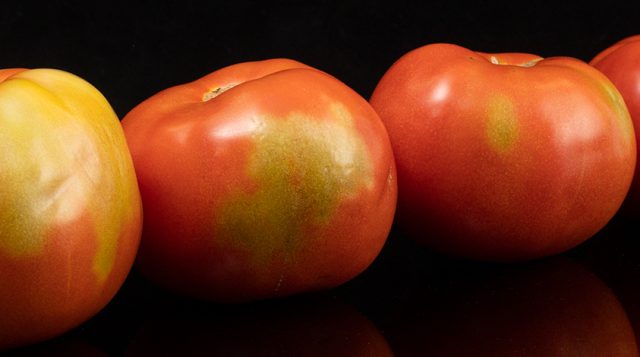
Early symptoms of GRSV infection are difficult to diagnose visually in all crops. Later symptoms can be quite striking, but molecular or serological analysis is necessary for definitive identification of GRSV. In tomato plants infected at an early age, characteristic symptoms consist of inward rolling of leaves and leaves that develop a bronze cast followed by dark brown spots or flecks. Irregular yellow areas are also sometimes present. As the infection progresses, additional symptoms develop, including brown streaks on the epidermis (skin) of the main stem and leaf petioles and wilting (or death) of the top portion of the plant (Figures 4a–6). Fruits may be deformed, show uneven ripening, and often have raised bumps, rings, or ring patterns on the surface (Figures 7a, 7b, and 7c).
Similar types of symptoms are also observed following GRSV infection of tomatillo and eggplant, with brown streaks on the epidermis of the main stem and death of the top portion of the plant. Yellow (chlorotic) or brown (necrotic) rings or spots also are observed on leaves and fruit husks of tomatillos.
GRSV symptoms in pepper closely resemble those induced by TSWV in pepper and include yellow and brown (chlorotic and necrotic) spots on newly developed leaves, inward rolling of leaves, and overall stunting of plants (especially if infected at an early age). Fruits are also deformed and off color, often with characteristic rings.
The initial characterization of GRSV was from peanut in South Africa, where stunting of the plant and small, distorted leaves with severe yellowing (chlorosis) and concentric ringspots were reported.
Host Range
The relatively narrow reported host range of GRSV contrasts with the extremely wide host range of TSWV. Both viruses induce similar symptoms on tomato, pepper, and tomatillo, as noted above. GRSV has previously been found in Argentina, Brazil, and South Africa infecting hosts such as tomato, pepper, peanut, soybean, and coriander. Alternate hosts for GRSV in Florida are being explored. Growers are advised to watch for and report suspicious symptoms on weeds and other solanaceous crops, like potato, and legumes (especially peanut).
Disease Transmission
GRSV is reported to be transmitted by several species of thrips, including the western flower thrips (Frankliniella occidentalis) and common blossom thrips (F. schultzei and F. gemina). The virus must be acquired by larval thrips from an infected plant for subsequent transmission as adults. Transmission occurs in a circulative propagative manner, meaning that the virus multiplies in the thrips as well as its plant host.
Transmission of Florida GRSV isolates by western flower thrips has been demonstrated recently. The ability of additional locally important thrips species to acquire and transmit GRSV is now being tested in the state.
Management
Management of this virus and its thrips vectors is difficult. Once a plant becomes infected with GRSV, it cannot be cured. To prevent spread of the virus, infected plants should be immediately rogued to prevent spread to neighboring plants. This is especially true in transplant production. Control of western flower thrips (and potentially other thrips vector species yet to be identified in Florida) is important to reduce spread of the virus by these vectors.
The close relationship of GRSV and TSWV likely indicates that integrated management strategies developed and currently used for TSWV in North Florida will also be effective for GRSV. These include the use of virus-free transplants (produced by excluding thrips from plant houses, which may prove to be very difficult to achieve) and the use of metalized (UV-reflective) mulch developed for TSWV control by scientists at UF’s North Florida Research and Education Center in Quincy. This integrated management approach combines the use of insecticides to reduce thrips larval development (to limit secondary virus spread) with UV-reflective mulches and acibenzolar-S methyl (Actigard®). It has provided excellent management of TSWV in commercial tomato fields in North Florida and may help control GRSV in South Florida.


Additional Resources
Webster, C. G., K. L. Perry, X. Lu, L. Horsman, G. Frantz, C. Mellinger, and S. Adkins. 2010. “First Report of Groundnut Ringspot Virus Infecting Tomato in South Florida.” Plant Health Progress. doi: 10.1094/PHP-2010-0707-01-BR.
Webster, C. G., S. R. Reitz, K. L. Perry, and S. Adkins. 2011. “A Natural M RNA Reassortant Arising from Two Species of Plant- and Insect-Infecting Bunyaviruses and Comparison of Its Sequence and Biological Properties to Parental Species.” Virology 413:216–225.
Webster, C. G., W. W. Turechek, H. C. Mellinger, G. Frantz, N. Roe, H. Yonce, G. E. Vallad, and S. Adkins. 2011. “Expansion of Groundnut Ringspot Virus Host and Geographic Ranges in Solanaceous Vegetables in Peninsular Florida.” Plant Health Progress. doi: 10.1094/PHP-2011-0725-01-BR.