Vegetarian Newsletter
A
Vegetable Crops Extension Publication
University of
Florida
Institute of Food and
Agricultural Sciences
Cooperative Extension Service
Vegetarian 01-03
March 2001
List of Extension Vegetable Crops Specialists
| (Note: Anyone is free to use the information in this newsletter. Whenever possible, please give credit to the authors. The purpose of trade names in this publication is solely for the purpose of providing information and does not necessarily constitute a recommendation of the product.) |
| 2001 FL107 In-Service: April 23-25: Beneficials and Biorationals for Vegetable Pest Management. |
| Small Farm Conference and Trade Show 2001 - April 7, 2001- 8:30-3:00 - Volusia County Fairgrounds, Deland. Contact Richard Tyson at (407)665-5554 or rvt@gnv.ifas.ufl.edu or Betsy Lamb at (561)468-3922 x138 or eml@gnv.ifas.ufl.edu. |
| Gulf Coast Research and Education Center Vegetable Field Day - Tuesday, 15 May 2001 - Bradenton, FL. Contact Donald N. Maynard at (941)751-7636 x239 or dnma@mail.ifas.ufl.edu. |
| Twilight Field Day - June 5 - NFREC-Suwannee Valley. Contact Bob Hochmuth at 386-362-1725 or bobhoch@gnv.ifas.ufl.edu. |
| Florida State Horticulture Meeting - June 10-12 - Stewart, FL. |
| American Society for Horticultural Sciences Annual Meeting - July 22-25 - Sacramento, CA. |
| Florida Tomato Institute - Sept. 5 - Naples, FL. |
| Florida Agriculture Extension Professionals Meeting - Sept. 10-14. |
| FACTS Meeting - Oct. 2-3 - Lakeland, FL. |
| Cucurbitaceae 2002 - December 8-12, 2002 - Naples Beach and Golf Club, Naples, FL. Contact Donald N. Maynard at (941)751-7636 x239 or dnma@mail.ifas.ufl.edu. |
Upcoming In-service: Beneficials and Biorationals for Vegetable Pest Management |
At the end of March, we=ll send out more detail. Please call or e-mail Susan Webb (352-392-1901 x158; sewe@ufl.edu) or Steve Sargent (352-392-1928 x215; sasa@mail.ifas.ufl.edu) for more information.
Beneficials and Biorationals for Vegetable Pest Management B 23-25 April
Monday afternoon (1:00PM -
8:00PM): |
BREAK |
Entomology & Nematology
Teaching Lab (2216), Bldg. 970 |
BREAK |
Catered Dinner (Courtyard, Entomology & Nematology) |
Tuesday morning (8:00AM - 1:00PM): |
Meet at Fifield Hall |
Tuesday afternoon (1:00 PM B 5:30 PM): |
1304 B1306 Fifield Hall |
BREAK |
Entomology & Nematology
Computer Teaching Lab (1027), Bldg. 970 |
Dinner at local restaurant with group or on your own |
Wednesday morning (8:00AM - 12:00 noon): |
1304-1306 Fifield Hall |
(Sargent and Webb, assoc. prof., Entomology and Nematology Dept., Vegetarian 01-03)
Evaluation of Potato Varieties in the NE184 Regional Selection Program Under Florida Growing Conditions |
Potatoes are an economically important crop for Florida. Potatoes are grown on approximately 40,000 acres state wide with an approximate annual value of $140 million. Potato growers in Florida are interested in new varieties that demonstrate higher yield, increased disease resistance or tolerance, more uniform tuber size distribution, and better processing characteristics compared to standard varieties. New potato varieties must be continually tested against standard commercial varieties to determine if they possess advantages that will allow producers to remain competitive in the global marketplace. The variety trials reported here were conducted to provide information on the performance and adaptation of new potato clones under Florida growing conditions. The data will be combined with results from trials from East coast states to evaluate variety performance under a wide range of geographic, climatic, soil, and cultural conditions. The tests at the Hastings REC contribute to the Regional Project NE184 entitled, "Development of New Potato Clones and Varieties in the Northeast."
The trial was conducted at the Hastings Research and Education Centers Yelvington Farm in Hastings, FL. Crops in the tri-county area around Hastings, Florida are grown in 60-foot wide beds consisting of sixteen rows. The rows are raised with a between row spacing of 40 inches (center to center). The soil at the field site is classified as Ellzey fine sand (sandy, siliceous, hyperthermic Arenic Ochraqualf; sand 90-95%, < 2.5% clay, < 5% silt). The crop was irrigated with seepage irrigation as needed.
Potatoes were planted in beds following a sorghum/sudan grass summer cover crop (Sorghum bicolor (L.) Moench x S. arundinaceum (Desv.) Stapf var. SX17, Dekalb Genetics Corporation, Dekalb, IL). The cover crop was disked into the potato beds in September 1999. Potato beds were fumigated with 1,3-dichloropropene (Telone II, Dow Chemical, Indianapolis, IN, 58 L/ha) in early January 2000.
Varieties were replicated in single row 20 ft plots. Seed pieces were hand cut to an approximate size of 2.5 oz prior to planting on an eight inch within row spacing with a carousel planter. The potato rows were hilled after plant emergence. Metribuzin (Lexone DF, 20 oz a.i./acre) was broadcast on the bed at hilling.
Fertilizer (1100 lb/acre 14-2-12 granular) was incorporated into the beds prior to planting. An additional 700 lb of 14-2-12 was side-dressed five weeks after planting.
Plots were harvested with a single-row commercial potato digger. Potatoes were graded using commercial grading equipment. Tubers were washed and culls were removed and weighed. The remaining potatoes were separated into five size classes and weighed. A 20-tuber sample was randomly chosen from each plot and used to calculate specific gravities following the weight in air/weight in water method. After gravities were calculated, the sample was rated for appearance characteristics and sliced into quarters to rate for internal problems. Plant maturity and plant size were rated at full flower. Tuber skin color, skin texture, tuber shape, eye depth, and overall appearance were rated at harvest following NE184 protocols.
Due, in part, to its performance in the NE184 trial, AF1615-1 is being evaluated in 2001 on five Florida grower sites including 23 acres of commercial farm ground. AF1615-1 may be considered for joint release pending data from the 2001 commercial trials.
Table 1. Florida Rating Code Table Plant and Tuber Characteristicsz |
|||||
Plant Characteristics |
|||||
Rating Code |
Plant Size |
Air Pollution |
Vine Maturity |
Plant Appearance |
Vine Maturity at Vinekill |
1 |
Very Small |
Dead |
Very Early |
Very Poor |
Completely Dead |
2 |
+ |
-- |
Early |
Poor |
-- |
3 |
Small |
Mod. Defol. |
+ |
+ |
Yellow and Dying |
4 |
+ |
-- |
Med. Early |
-- |
-- |
5 |
Medium |
Mod. Injury |
Medium |
Fair |
Moderately Mature |
6 |
+ |
-- |
Med. Late |
+ |
-- |
7 |
Large |
Mild Injury |
+ |
-- |
Starting to Mature |
8 |
+ |
-- |
Late |
Good |
-- |
9 |
Very Large |
No Symptoms |
Very Late |
Excellent |
Green and Vigorous |
Tuber Characteristics |
|||||
Rating Code |
Skin Color (SC) |
Skin Texture (ST) |
Tuber Shape (TS) |
Eye Depth |
Overall Appearance |
1 |
Purple |
Part. Russet |
Round |
Very Deep |
Very Poor |
2 |
Red |
Heavy Russet |
Mostly Round |
-- |
-- |
3 |
Pink |
Mod. Russet |
Round to Oblong |
Deep |
Poor |
4 |
Dark Brown |
Light Russet |
Mostly Oblong |
-- |
-- |
5 |
Brown |
Netted |
Oblong |
Intermediate |
Fair |
6 |
Tan |
Slight Net |
Oblong to Long |
-- |
-- |
7 |
Buff |
Mod. Smooth |
Mostly Long |
Shallow |
Good |
8 |
White |
Smooth |
Long |
-- |
-- |
9 |
Cream |
Very Smooth |
Cylindrical |
Very Shallow |
Excellent |
z Based on the standard NE184 rating codes for plant and tuber characteristics. |
|||||
Table 2. Production Statistics for NE184 Variety Trial Results at the Hastings REC. |
||||||||||||||
Planted: 2/17/2000 |
||||||||||||||
Potato Variety |
Total Yield |
Market Yieldx |
% Stand |
Size |
Size |
Specific Gravity |
||||||||
Distribution by Class (%)y |
Distribution (%) |
|||||||||||||
1 |
2 |
3 |
4 |
5 |
2 to 5 |
3 to 5 |
||||||||
Atlantic |
424 |
abz |
398 |
ab |
99 |
2 |
21 |
39 |
34 |
1 |
95 |
74 |
1.0788 |
bc |
Katahdin |
365 |
c-f |
343 |
d-g |
94 |
2 |
23 |
34 |
36 |
1 |
95 |
71 |
1.0700 |
fg |
Kennebec |
414 |
ab |
390 |
a-c |
96 |
1 |
19 |
33 |
43 |
2 |
96 |
77 |
1.0655 |
hi |
Rus. Norkotah #3 |
324 |
f-h |
300 |
h-k |
100 |
3 |
45 |
33 |
14 |
0 |
93 |
47 |
1.0615 |
j-l |
Rus. Norkotah #3117 |
312 |
hi |
288 |
jk |
100 |
5 |
53 |
32 |
8 |
0 |
92 |
40 |
1.0655 |
hi |
Shepody |
314 |
g-i |
293 |
i-k |
100 |
3 |
34 |
33 |
26 |
0 |
93 |
60 |
1.0770 |
cd |
Snowden |
419 |
ab |
396 |
ab |
98 |
2 |
27 |
39 |
28 |
1 |
95 |
68 |
1.0820 |
ab |
Superior |
273 |
ij |
241 |
lm |
100 |
7 |
59 |
25 |
5 |
0 |
88 |
29 |
1.0758 |
cd |
Yukon Gold |
329 |
e-h |
302 |
g-k |
98 |
3 |
21 |
36 |
34 |
1 |
92 |
71 |
1.0740 |
de |
La Chipper |
369 |
c-e |
337 |
d-h |
98 |
4 |
34 |
31 |
26 |
1 |
93 |
59 |
1.0690 |
fg |
A8495-1 |
167 |
k |
132 |
n |
81 |
20 |
72 |
6 |
1 |
0 |
79 |
7 |
1.0700 |
fg |
AF1437-1 |
281 |
i |
211 |
m |
99 |
1 |
27 |
27 |
22 |
0 |
76 |
49 |
1.0583 |
lm |
AF1615-1 |
399 |
bc |
375 |
b-d |
95 |
2 |
32 |
44 |
18 |
0 |
94 |
62 |
1.0675 |
gh |
AF1758-7 |
236 |
j |
210 |
m |
100 |
6 |
41 |
31 |
17 |
0 |
89 |
48 |
1.0570 |
m |
AF1763-2 |
371 |
cd |
348 |
c-f |
99 |
3 |
36 |
40 |
19 |
0 |
94 |
58 |
1.0620 |
jk |
AF1775-2 |
278 |
i |
264 |
kl |
89 |
2 |
34 |
38 |
23 |
0 |
95 |
61 |
1.0828 |
a |
A84180-8 |
355 |
d-g |
327 |
e-j |
100 |
5 |
45 |
36 |
11 |
0 |
93 |
47 |
1.0693 |
fg |
B0766-3 |
368 |
c-e |
341 |
d-h |
100 |
1 |
16 |
24 |
53 |
3 |
95 |
80 |
1.0783 |
b-d |
NY103 |
401 |
bc |
365 |
b-e |
94 |
1 |
24 |
40 |
27 |
1 |
91 |
68 |
1.0713 |
ef |
NY115 |
452 |
a |
423 |
a |
100 |
2 |
20 |
38 |
36 |
0 |
94 |
73 |
1.0695 |
fg |
W1242 |
397 |
bc |
367 |
b-e |
99 |
2 |
21 |
35 |
36 |
2 |
95 |
74 |
1.0768 |
cd |
W1313 |
341 |
d-h |
320 |
f-j |
99 |
4 |
37 |
36 |
21 |
0 |
94 |
57 |
1.0838 |
a |
Norland, Dark Red (red) |
307 |
hi |
286 |
jk |
100 |
4 |
50 |
29 |
14 |
0 |
93 |
44 |
1.0630 |
i-k |
NorDonna (red) |
362 |
c-f |
334 |
d-i |
99 |
3 |
38 |
36 |
19 |
0 |
93 |
55 |
1.0645 |
h-j |
Red La Soda (red) |
401 |
bc |
369 |
b-e |
99 |
3 |
28 |
34 |
29 |
2 |
93 |
65 |
1.0608 |
kl |
x Marketable Yield: size classes 2 to 4. ySize Classes: 1 = <1 7/8" (B); 2 = 1 7/8 to 2 ½"; 3 = 2½ to 3¼"; 4 = 3¼ to 4"; 5 = >4".zMeans separated within columns with Waller-Duncan mean separation test at P<0.05. |
||||||||||||||
Table 3. Plant and Tuber Characteristics for NE184 Variety Trial Results at the Hastings REC. |
||||||||||||||
Planted: 2/17/2000 |
||||||||||||||
Potato Variety |
Total
Yield |
Market
Yieldx |
Plant |
Vine |
Tuber Characteristics |
|||||||||
T |
S |
S |
E |
A |
Hy |
Iy |
Cy |
|||||||
S |
T |
C |
D |
P |
H |
N |
R |
|||||||
Atlantic |
424 |
abz |
398 |
ab |
8.8 |
6.5 |
3 |
5 |
7 |
5 |
6 |
5.0 |
0.0 |
0.0 |
Katahdin |
365 |
c-f |
343 |
d-g |
6.5 |
6.8 |
3 |
8 |
8 |
6 |
6 |
1.3 |
0.0 |
0.0 |
Kennebec |
414 |
ab |
390 |
a-c |
6.8 |
7.8 |
5 |
8 |
8 |
6 |
5 |
0.0 |
0.0 |
1.3 |
Rus. Norkotah #3 |
324 |
f-h |
300 |
h-k |
4.0 |
8.8 |
7 |
3 |
5 |
6 |
6 |
0.0 |
0.0 |
0.0 |
Rus. Norkotah #3117 |
312 |
hi |
288 |
jk |
5.0 |
6.5 |
7 |
1 |
5 |
4 |
6 |
0.0 |
0.0 |
0.0 |
Shepody |
314 |
g-i |
293 |
i-k |
6.0 |
6.5 |
5 |
8 |
8 |
7 |
7 |
0.0 |
0.0 |
0.0 |
Snowden |
419 |
ab |
396 |
ab |
7.5 |
6.0 |
3 |
5 |
7 |
5 |
7 |
1.3 |
1.3 |
1.3 |
Superior |
273 |
ij |
241 |
lm |
6.3 |
4.5 |
2 |
6 |
8 |
4 |
7 |
1.3 |
2.5 |
0.0 |
Yukon Gold |
329 |
e-h |
302 |
g-k |
8.0 |
5.0 |
3 |
6 |
9 |
7 |
7 |
0.0 |
12.5 |
0.0 |
La Chipper |
369 |
c-e |
337 |
d-h |
6.0 |
7.5 |
2 |
8 |
8 |
4 |
8 |
0.0 |
0.0 |
0.0 |
A8495-1 |
167 |
k |
132 |
n |
2.0 |
9.0 |
8 |
1 |
5 |
6 |
5 |
0.0 |
0.0 |
0.0 |
AF1437-1 |
281 |
i |
211 |
m |
5.0 |
5.5 |
3 |
6 |
7 |
7 |
5 |
0.0 |
0.0 |
0.0 |
AF1615-1 |
399 |
bc |
375 |
b-d |
7.0 |
6.5 |
3 |
6 |
7 |
7 |
5 |
0.0 |
0.0 |
0.0 |
AF1758-7 |
236 |
j |
210 |
m |
7.3 |
7.5 |
2 |
6 |
7 |
6 |
5 |
0.0 |
0.0 |
0.0 |
AF1763-2 |
371 |
cd |
348 |
c-f |
5.5 |
6.5 |
5 |
8 |
8 |
5 |
5 |
0.0 |
0.0 |
0.0 |
AF1775-2 |
278 |
i |
264 |
kl |
4.0 |
8.3 |
5 |
8 |
8 |
5 |
5 |
0.0 |
0.0 |
0.0 |
A84180-8 |
355 |
d-g |
327 |
e-j |
4.0 |
9.0 |
7 |
1 |
7 |
6 |
5 |
0.0 |
0.0 |
0.0 |
B0766-3 |
368 |
c-e |
341 |
d-h |
7.0 |
6.5 |
3 |
5 |
7 |
4 |
5 |
0.0 |
0.0 |
0.0 |
NY103 |
401 |
bc |
365 |
b-e |
5.5 |
8.0 |
3 |
8 |
8 |
6 |
6 |
0.0 |
0.0 |
0.0 |
NY115 |
452 |
a |
423 |
a |
7.0 |
6.8 |
4 |
8 |
8 |
7 |
6 |
0.0 |
0.0 |
0.0 |
W1242 |
397 |
bc |
367 |
b-e |
7.3 |
6.8 |
3 |
6 |
8 |
7 |
5 |
0.0 |
0.0 |
0.0 |
W1313 |
341 |
d-h |
320 |
f-j |
7.5 |
6.5 |
4 |
6 |
7 |
7 |
5 |
5.0 |
2.5 |
0.0 |
Norland, Dark Red (red) |
307 |
hi |
286 |
jk |
7.0 |
3.8 |
3 |
6 |
2 |
5 |
5 |
0.0 |
0.0 |
6.3 |
NorDonna (red) |
362 |
c-f |
334 |
d-i |
7.5 |
5.8 |
2 |
8 |
2 |
4 |
5 |
0.0 |
0.0 |
1.3 |
Red La Soda (red) |
401 |
bc |
369 |
b-e |
7.3 |
5.5 |
3 |
8 |
2 |
4 |
5 |
0.0 |
0.0 |
0.0 |
x Marketable Yield: size classes 2 to 4. yPercent of tubers showing injury. zMeans separated within columns with Waller-Duncan mean separation test at P<0.05. |
||||||||||||||
(Hutchinson, White and Weingartner, assoc. prof., Hastings REC, Vegetarian 01-03)
Restoring
the Competitiveness of Vegetable |
We conducted a field day of "Developing Sustainable Tomato Production in South Florida on Feb. 21, 2001 at Tropical Research and Education Center, Homestead. Over 30 growers, agricultural suppliers, researchers and congressional aides attended the field day. The following information was the part of our presentation.
THE PROBLEM: Five crops critical to the long term survival of the vegetable industry in Florida are tomato, bell pepper, cucumber, egg plant and squash.
From 1990 to1998, the share of the U.S. vegetable market met by U.S. growers fell from 80 to 70%, and that of Florida growers from 35 to 25% (Van Sickle, 1999).
For tomato the loss of market share has been even greater. |
||
Percent of U.S. Market Supplied |
||
1992 |
2000 |
|
U.S. Tomato Producers |
90% |
67% |
Florida Tomato Producers |
47% |
25% |
Tomatoes: Cost of Production in Miami-Dade County
The preharvest cost of growing an acre of tomatoes is about $6,600, and a respectable yield is 1,400 twenty five-pound cartons per acre (Smith and Taylor, 2000).
Therefore the breakeven price is about $8.22 per carton in Miami-Dade County.

Breakeven Price in Mexico
Dr. John Van Sickle (2001) has tracked costs for operators in Mexico with regard to prouction, harvesting, marketing and export. Dr. Van Sickle's data indicate the breakeven price in Mexico for export into the United States, where labor is cheap, appears to be just about $7.00/carton.

Cover Crops: An Emerging Substitute for Methyl Bromide and Plastic Mulch
Dr. Herbert Bryan and colleagues are finding that we can replace methyl bromide through the use of those cover crops which are lethal to plant-parasitic nematodes. Cover crops such as sunn hemp, velvet bean, 'Iron and Clay' cowpeas, and Sesbania attract plant-parasitic nematodes to their roots and kill them (Bridge, 1996). These cover crops build down populations of plant-parasitic nematodes and other pathogens, and also convert atmospheric nitrogen into fertilizer.
Teams led by Dr. A. Abdul Baki, Beltsville Agricultural Research Center, and Professor Ron Morse, Virginia Tech, have been able to convert cover crops into organic mulches to replace plastic mulch for vegetable production in the mid-Atlantic States (Abdul-Baki and Teasdale, 1997; Morse, 1999).
If we succeed in perfecting such a biologically-based system for tomato production in Florida, savings of about $1,200 in preharvest costs would be realized. However even with these savings, the preharvest cost would still exceed $7.00/carton.
Clearly we cannot become competitive with Mexico unless we also increase tomato yield per acre.
Achieving Substantial Yield Increases in Tomato in Miami-Dade County
Fortunately yield per acre can be increased significantly. Dr. Yuncong Li and colleagues have shown at this Center that yield can be boosted by about 20 percent by adding organic matter to the soil.

Moreover, Dr. Li and colleagues found that by using tensiometers to properly control irrigation yields can be doubled. In the following example this team applied irrigation when the soil moisture tension reached 5 cbars and 20 cbars. Many growers irrigate when the moisture tension is roughly 5 cbars. However by delaying irrigation until the moisture tension had dried down to 20 cbars, yields were doubled as shown in this chart.

The Envisioned Tomato Production System
The aim of our research is to assemble a tomato production system in which we increase yields through proper irrigation and addition of organic matter to the soils, and use cover crops to replace the use of methyl bromide, plastic mulch and part of the fertilizer.
This system would affect the cost of tomato production about as shown in this chart:

Such a production system would reduce the breakeven price to below $6.00 per carton and allow Florida's growers to compete effectively with growers in Mexico.
Current Status of Development of Biologically-Based Tomato Production System
Literature Cited:
Abdul-Baki, A. A.and J. R. Teasdale. 1997. Sustaninable production of fresh-market tomatoes and other summer vegetables with organic mulches. Farmers' Bulletin No. 2279, 23 pp. USDA/ARS.
Bridge, J. 1996. Nematode Management in Sustainable and Subsistence Agriculture, Ann. Rev. Phytopathol. 34: 201-35.
Li, Y.C., H.H. Bryan, R. Rao, N. Heckert, and T. Olczyk. 1999. Summer Cover Crops for Tomato Production in South Florida, P.18-21. The proceedings of the Conference of Florida Tomato Institute, Citrus &Vegetable Magazine.
Li, Y C, M. Zhang, P. Stoffella. 2001. Nitrogen Availability in Vegetable Systems Amended with Biosolid - Yard Waste Compost. Annual Report. T-TAR/USDA.
Morse, R. D. 1999. No-till vegetable production - its time is now. HortTechnology, 9 (3): 373-379.
Smith, S. A. and T. G. Taylor. 2000. Tomatoes: Estimated production costs in Dade County area, 1999-2000, Table 33.
http://www.agbuscenter.ifas.ufl.edu/Van Sickle, J. 1999. Critical commodities in the Caribbean Basin: A Florida perspective. P. 191-196. In W. Klassen (chair), Mitigating The Effects Of Exotic Pests On Trade And Agriculture, Part A. The Caribbean. Proceedings of T-STAR Workshop-X, Homestead, Florida, June 16-18, 1999, sponsored by the Cooperative State Research, Education, and Extension Service, USDA. 292 pp.
Van Sickle, J. J. 2001. The impact of NAFTA on Florida Agriculture, 1994 -2000. PowerPoint presentation, 23 slides.
Van Sickle, J. J., C. Brewster and T. H. Spreen. 2000. Impact of a methyl bromide ban on U.S. vegetable industry. Bulletin 333, Department of Food and Resource Economics, Florida Cooperative Extension Service, IFAS, UF. 20 pp.
Http://edis.ifas.ufl.edu(Klassen, professor, TREC-Homestead and Li, Vegetarian 01-03)
Heated Dump Tanks Dont Soften Tomatoes |
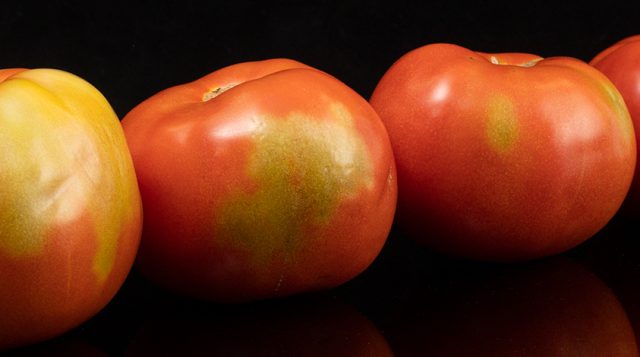
It has been reported that tomatoes, particularly "pinks", become more susceptible to bruising following immersion in heated dump tanks. To test this idea, we set up an extensive experiment last November, making every effort to simulate commercial conditions as closely as possible.
Freshly harvested Florida 47' tomatoes grown in the Palmetto area were collected at a range of ripeness stages (green, breaker, turning, pink, light red), returned to the laboratory and held overnight at 20oC (68oF). The following day, five tomatoes at each ripeness stage were submerged for 1, 2, 3 or 4 minutes in heated water (40oC; 104oF). Five tomatoes were not immersed as a control. Immediately upon removal from the water bath, firmness was measured on the equator of each tomato (two readings/fruit). Firmness was determined using an Instron Universal Testing Instrument fitted with a convex-tip probe 11 mm (0.4 inches) in diameter, and the force was recorded when the probe reached 1 mm deformation. This method nondestructively simulates manual measurement of firmness.
Not surprisingly, the results showed that tomato firmness decreased as tomato ripeness stage advanced (Table 1). With each advanced ripeness stage, firmness decreased from 15.7% to 21.3%.
Table 1. Tomato firmness at several ripeness stages 24 hours after harvest. |
||
Ripeness Stage |
Firmness (N) |
Loss in Firmness Between |
Green |
10.2 |
--- |
Breaker |
8.6 |
15.7 |
Turning |
7.2 |
16.3 |
Pink |
6.1 |
20.8 |
Light Red |
4.9 |
21.3 |
(1 Newton = 0.22 pound-force). |
||
However, tomato firmness within each ripeness stage category remained constant following immersion up to 4 minutes. These results indicate that "pink" tomatoes are more susceptible to bruising due to softening that occurs during normal ripening, and not due to temporary heating of the skin during dump-tank handling.
With the potential to market "pink" tomatoes as higher-priced vine-ripes, greater care must be taken during handling operations to minimize bruising and other mechanical injuries. Lowering drop heights during handling, installing suspended curtains where tomatoes are tossed during sorting, and using shorter-height shipping containers are straight-forward, but effective, means to reduce injuries. Residence time in the dump tank should be from two to three minutes to reduce pathogen loads, but immersion more than three minutes should be avoided to minimize water infiltration into the tomatoes.
(Sargent and Abbie J. Fox, postharvest bio. sci., Vegetarian 01-03)

Growing Garden Tomatoes in Cans |
Growing good, big, juicy, red-ripe tomatoes will be the aim of many thousands of Florida home gardeners this spring season. To grow tomatoes, with space limitations, one should consider "canning" tomatoes that is, growing them in cans.
Tomatoes grown in cans and other containers produce well, and make attractive plants. To enhance the landscape, cans may be placed at strategic locations around the exterior of the home.
Furthermore, tomato fruits produced in this manner are just as tasty and nutritious as those grown in the ground.
This article describes a method of "can culture" used successfully in a home garden in central Florida. The principles used were sound, and the results were outstanding. There is every reason to believe that the system will work just as well for you.
Containers: The gardener used 5-gallon square cooking oil cans. Anything similar, such as paint buckets, bushel baskets or plastic garbage cans may be used. Do not use smaller containers unless varieties suitable for hanging baskets are planted.
Location: A four-foot wide strip of black polyethylene was laid out on the ground. It was long enough to accommodate about 24 cans. The cans were placed on the mulch in full sunlight. Containers may be placed wherever they might be most attractive. Since the containers have their own soil, they can be placed on hard surfaces such as concrete patios or wooden decks (even boat decks).
Soil: Sawdust was used as a soil-substitute. It is important to use well-rotted, old sawdust for best results. Although this gardener did not put anything else in the sawdust at the time it was placed into the cans, it is advisable to mix about a half cup of dolomite in each can to provide sufficient calcium for preventing blossom-end rot.
Varieties: Plants were set directly into the sawdust. The varieties used were Floradel, Walter, Big Boy, and Stakeless. Best production was obtained from Walter and Floradel and least from Stakeless. Big Boy was only fair. Other varieties suggested for use are Floramerica, , Better Boy, and Solar-Set! Also, the small-fruiting varieties such as Summer Cherry do well in can culture. The latter will also permit growing into the warm summer months.
Fertilizer and Watering: A fertilizer solution was prepared and applied daily to each can. The fertilizer solution was mixed in a five gallon container. The gardener mixed two tablespoonfuls of high analysis soluble fertilizer into five gallons of water. One gallon of this solution was poured into each tomato can once each day. At the end of each week, the fertilizer was omitted and, instead, each container of sawdust was given a thorough wetting with the garden hose. The purpose was to wash out accumulated salts from the fertilizer, since soluble salt buildup can cause root injury.
Alternatives to the methods of fertilizing used might be mixing a slow-release fertilizer into the sawdust before planting; or twice weekly light applications of dry common fertilizer such as 8-8-8 to the sawdust surface followed by watering in.
Staking and Supporting: All varieties should be supported so that they are made to grow in an upright position. Regular methods of supporting such as staking and string-trellising may be used. Caging with wire is perfect.
Further care: The usual care and attention was provided as the plants grew. Some pruning was done to remove unwanted suckers. Pesticides, as needed, were sprayed onto the plants. Weeds were not a problem, since the black plastic kept the weeds away from the area around the cans, and the sawdust contained no weed seeds.
(Stephens, Vegetarian 01-03)
Extension Vegetable Crops Specialists| Daniel J. Cantliffe Professor and Chairman, Horticultural Sciences Department |
Mark
A. Ritenour Assistant Professor, postharvest |
Timothy E. Crocker |
Ronald W. Rice Assistant Professor, nutrition |
| John Duval Assistant Professor, strawberry |
Steven A. Sargent Professor, postharvest |
| Chad Hutchinson Assistant Professor, vegetable production |
Eric Simonne Assistant Professor and Editor, vegetable nutrition |
| Elizabeth
M. Lamb Assistant Professor, production |
William M. Stall Professor, weed control |
| Yuncong Li Assistant Professor, soils |
James M. Stephens Professor, vegetable gardening |
| Donald N.
Maynard Professor, varieties |
Charles S. Vavrina Associate Professor, transplants |
| Stephen M. Olson Professor, small farms |
James M. White Associate Professor, organic farming |
Related Links: